
Decide
When Does a Concrete Driveway Actually Need Replacing?
Burlington has already written the answer down in numbers, for its own sidewalks. Take a tape measure to your driveway and you can apply the same test.
Almost every article on this subject asks you to judge whether damage looks "severe" or "extensive". That is useless when you are standing on your own driveway trying to decide whether to spend thousands.
So borrow a better test. The City of Burlington sets out, in its ordinance, the exact point at which a concrete sidewalk section stops being repairable and has to be replaced. Those thresholds are written for public walks rather than private driveways, but the concrete does not know the difference, and they give you something to measure instead of something to feel.
What replacing it costs, once you have decided
Two published components from HomeGuide, and both apply to a replacement:
- Taking the old surface out: $2 to $6 for every square foot
- Laying its replacement: $6 to $15 for every square foot
That is why a replacement quote sits above the figure you find when you search what a driveway costs. Those searches price a pour onto clear ground. Yours is not clear.
The city's three thresholds
Burlington's code requires replacement of a sidewalk section in three defined situations. Take a tape measure and a straightedge to your driveway and check each one.
1. A height difference of three-quarters of an inch or more
Where one section sits three-quarters of an inch or more above or below its neighbour, the code requires the entire misaligned section to be replaced and realigned. Not patched at the joint. The section.
Measure at the worst joint, laying a straightedge across it. This is the threshold most driveways hit first, and it is the one that says something has moved underneath rather than worn on top.
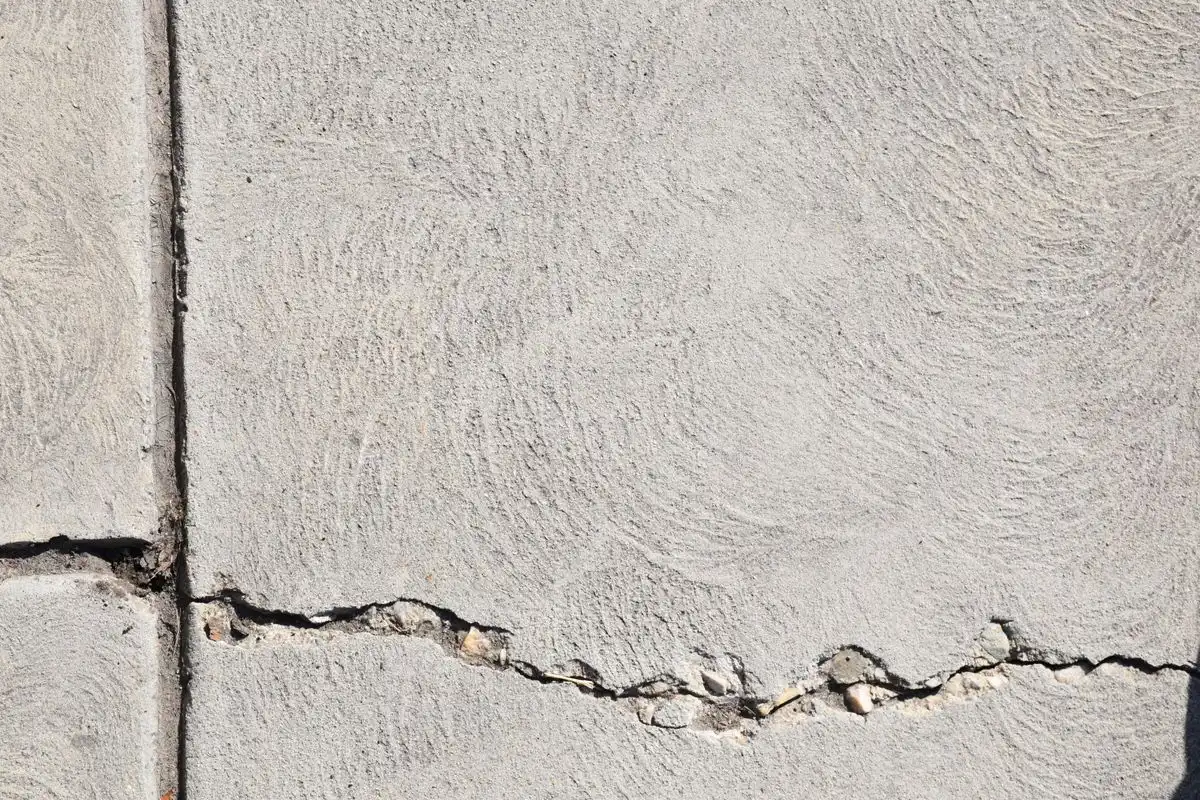
2. Crack openings of three-quarters of an inch or wider
One or more cracks in a section with openings of 3/4 inch or larger, and the code again calls for the whole section to be replaced.
Note that it is the opening that matters, not the length. A long hairline is a different animal from a short crack you can get a finger into. Measure the gap at its widest.
3. Scaling or cracking that makes the section unsafe
The judgement clause, and the one that covers surfaces which have lost their top layer to years of salt until the aggregate is exposed and the surface is breaking up underfoot.
The clause that matters most for a driveway
There is a fourth thing in that ordinance and it is the most useful line of the lot.
Topping a low slab with concrete or blacktop, or ramping from a low slab up to a higher one, is permitted only as a temporary repair until complete reconstruction can be made.
The city allows the quick fix and simultaneously refuses to call it a fix. That is worth carrying to your own driveway, because ramping a settled panel is exactly what gets offered when a homeowner asks for something cheaper. It is a legitimate way to buy a season or two. It is not a repair, and the ordinance says so in writing.
Not sure what you are looking at?
Four quick questions and a local concrete contractor will be in touch to set up a free on-site estimate. If your driveway passes the test, we will tell you so.
Passing the test does not mean doing nothing
Plenty of driveways fail none of the three thresholds and still look tired. Surface flaking, light crazing, a dull scaled patch where salt has collected over winters. All of that is cosmetic while the slab beneath is sound, and it is a resurfacing conversation rather than a replacement one.
The distinction to hold on to is movement against wear. Wear stays level. Movement does not. Every one of the city's thresholds is really a movement test in disguise, which is why they are good ones.
Where the verdict is wear rather than movement, the work that follows is on the concrete repair page rather than this one.
Failing the test: why the section moved
Once you know replacement is warranted, the question that decides whether the new driveway outlives the old one is why the old one failed.
Nearly always it is what sits beneath. Soft ground left in place, fill brought up all at once instead of in stages, or standing water that never found a route away - each of them going to work on the slab through every freeze and thaw a winter here delivers. Concrete seldom fails on its own account in this county.
Which is why the moment the old slab comes off is worth paying attention to. That is the only time in twenty years anyone can see the subgrade, and correcting it then costs a fraction of discovering it again through fresh concrete. Expect a bid to name an allowance for that work and to say what would take the job past it.
What a good replacement bid already states
- Which of the three thresholds your driveway fails, and where
- Whether the whole driveway or specific sections are being replaced, and why
- The removal rate per square foot and where the material goes
- An allowance for subgrade correction, and what would exhaust it
- Who obtains the DPW permit for any work at the curb, sidewalk or apron
The Burlington paperwork
A replacement that touches the curb, gutter, sidewalk or driveway approach needs a permit from the Department of Public Works before work begins, and the city is specific about how a curb may be opened - two permitted methods, with vertical sawing of the curb head prohibited outright. The detail is on our Burlington driveway cost page, and it is worth reading before you book a crew rather than after.
Afterwards
A new slab wants a specific first year, and grit rather than chemicals through the opening winter. The full schedule is on the driveway cost page. Plenty of Burlington drives get replaced in the same week as the back garden, and if that is the plan here, what a patio adds to the pour is worth pricing at the same time, since the mobilisation is already paid for.
Sources
- City of Burlington Code, Ch. 274 Streets and Sidewalks - the three replacement thresholds (three-quarter inch height difference, 3/4 inch crack openings, unsafe scaling or cracking), the temporary-repair status of topping and ramping, and DPW permit requirements.
- HomeGuide - the $2 to $6 removal adder and the $6 to $15 pouring rate. Verified 2026-08-18.
- Wisconsin Ready Mixed Concrete Association - driveway care and curing.
- NRMCA CIP 2 - scaling and the freeze-thaw mechanism.