
Cost
Concrete Driveway Cost in Burlington
Four published price tiers, only one of which most homes need, and a set of city rules that govern the kerb rather than the driveway.
There are two decisions in a driveway project. Which quality tier you are buying, and what happens where your driveway meets the street. The first is where most of the money goes. The second is where Burlington has opinions. Once you know which tier fits, the concrete driveway in Burlington, WI page is where the work itself gets scoped and quoted on site.
The four tiers, as published
HomeGuide sorts concrete driveways by quality rather than by size:
- Standard, $6 to $10 a square foot - plain grey concrete
- Basic decorative, $10 to $15 - a single-colour stain, a basic stencil or border, broom-finish texture, exposed aggregate
- Mid-range, $15 to $20 - stamped patterns, two or three colours, a contrasting border, engraved or scored work
- High-end, $20 to $25 and above - multiple techniques combined
Their national figures. The useful thing about a tier table rather than a single range is that it makes the decision explicit: you are not choosing a price, you are choosing a tier, and the price follows.
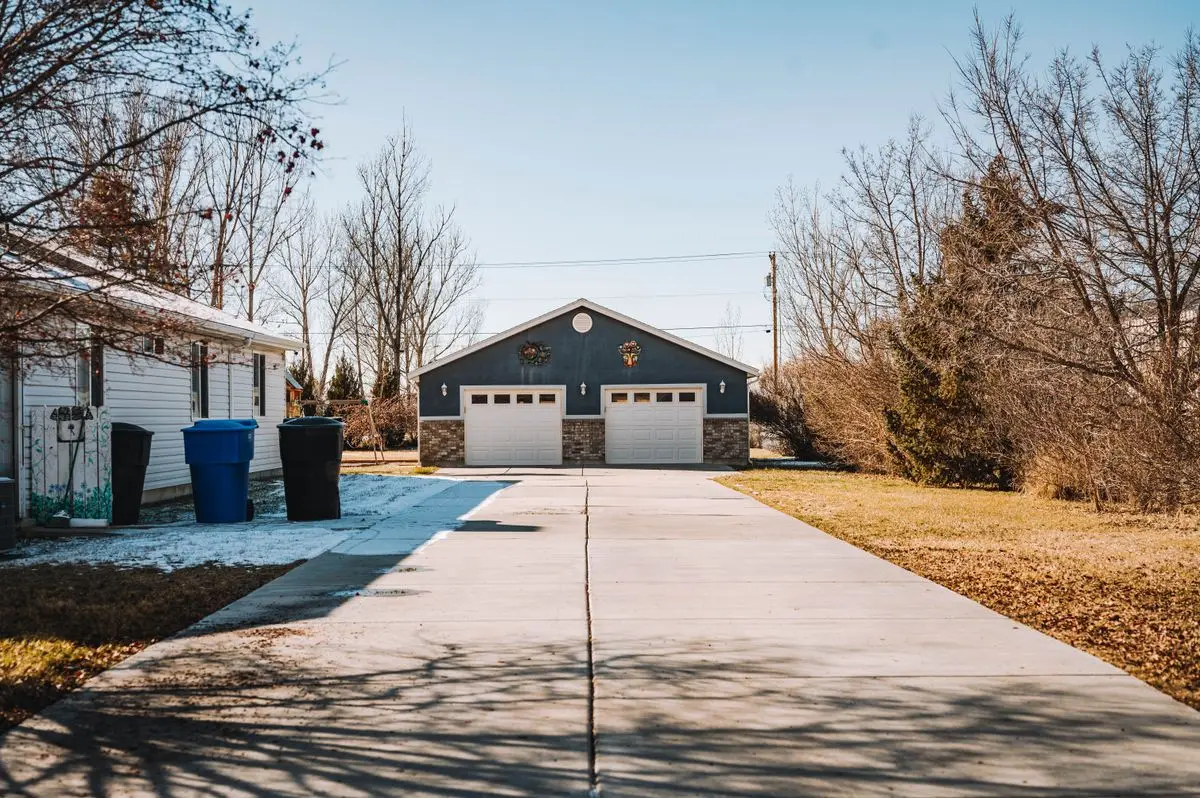
Which tier you actually need
Standard, for most houses in this area, and we would say that even though it is the cheapest row. A plain broom-finished slab handles freeze-thaw and road salt exactly as well as the tiers above it. Durability lives in the depth, the base and the air content, none of which appear in the tier table at all.
Where the higher tiers genuinely earn their money is appearance, and that is a legitimate thing to buy. A driveway is the largest visible surface on most properties. If you want it to look like something, the mid-range tier is where stamping and colour become convincing.
The one thing we would argue with is choosing a decorative tier under the impression that it wears better. It does not, and it carries a string attached: the colour and the shine are held in a sealer, that sealer degrades, and topping it up joins the list of things the house asks of you. Grey concrete makes no such demand.
The other direction: buying too little
The tier table describes surfaces, not structure, which is why it is possible to buy the right tier and still get the wrong driveway.
Depth is the item to watch. Ordinary cars sit happily on four inches. Six becomes the correct specification once something substantial stands there week in and week out - a motorhome, a laden trailer, a work truck - since a slab carrying more than it was built for comes apart across its whole section rather than wearing at the surface, and a break of that kind has no repair.
Get the quoted depth stated, and establish whether that figure describes the finished slab once the base beneath it has been rolled. The two readings are not the same.
What Burlington says about the kerb, and what it adds to a bill
Here is where a local page is worth reading. The city's rules concentrate on the transition between your property and the street, they are unusually specific, and every clause in them is time that somebody bills for.
Two of them move a driveway quote on their own. Work at the street cannot begin until the Department of Public Works has issued a permit, so that permit sets your start date. And the city prescribes the technique for opening a kerb, which rules out the quickest method a crew might otherwise price for.
The full set - the permitted methods and the banned one, how fees band by depth, the tie rods, the minimum section length, the gravel base beneath and the finished curbline heights - has its own page, because it is a specification rather than a price: the two legal ways to open a kerb here. Read it before you compare quotes. It is the cheapest bid-sorting tool you have.
Get a real number for your driveway
Four quick questions and a local concrete contractor will be in touch to set up a free on-site estimate. No obligation, and "just pricing it out" is a perfectly good answer.
What else moves the figure
What lies below. Excavation, imported stone, and compaction taken in stages. This is the item that determines whether a Racine County driveway survives, and correspondingly the easiest one to quietly reduce when a number needs to look competitive.
Getting the mix to the forms. Straight off the chute is quick. The moment concrete has to be moved across a site by barrow or pushed through a pump, you are buying hours.
Air content. Salt arrives on every driveway in this county each winter, the toughest duty residential concrete faces. Deliberately entrained air is the defence, and the specification is a fair thing to raise with a bidder.
Jointing. Roughly two to three feet of spacing for every inch of slab, sawn a quarter of the way in, laid out in advance. The slab will crack; the joints decide the route.
The question that sorts the quotes
One question does more work than a checklist: who is applying to DPW, and what will the application say? An experienced local bidder answers with the kerb method, the depth being placed and where the old material goes, because those are the things the city asks them. Why that works, and what each possible answer tells you, is set out on the kerb page.
The one shopping trip that decides how it ages
Aftercare on a new slab comes down to what you put in the boot of the car in October. Everything else looks after itself. Concrete does not much care what shape you poured it in, so a patio and a garage pad want this same treatment, and the other Basics pages link across to it.
Buy sand, or plain grit. It gives you traction underfoot and it does absolutely nothing to concrete. That is the entire list.
Leave the deicers on the shelf, all of them, for the first winter. A slab in its opening season is still carrying water and has not yet matured enough to survive being frozen while it does. Every product in that aisle works by keeping meltwater sitting on the surface and running the concrete through extra freeze cycles, which attacks both weaknesses at once.
Be especially wary of the bag marked gentle. Magnesium and calcium chloride get sold as the concrete-safe choice and the evidence runs the other way. Oregon's transportation department compared chloride deicers for how much compressive strength each removed, and magnesium came out worst of those tested. Wisconsin's ready mixed association keeps both away from concrete.
Two things that are not purchases. Keep vehicles off for the first seven days, because the slab cannot yet carry a car without taking an impression. And wait roughly a month before sealing, so the concrete has dried enough for a sealer to grip - optional on a plain finish, not optional on anything coloured, since that is where the colour is held.
From the second winter onward the slab copes far better, though scaling is cumulative rather than forgiven. Sticking with sand is the cheapest way to buy yourself extra years of a driveway that still looks new.
A job we will turn down
Sometimes the correct recommendation is somebody else's phone number. A driveway whose concrete is still sound but whose panels have settled out of line does not want replacing; it wants raising, which is a specialism with its own machinery and its own contractors. We do not offer it. Given the choice between sending you to them and watching a serviceable driveway go in a skip, we will send you to them.
What decides eligibility is the condition of the material, not how pronounced the step has become. Lifting puts concrete back where it should be without mending any of it, so a driveway whose panels have already come apart just ends up broken at the correct level.
Once the budgeting is done, the build itself is on our concrete driveway page: what we put down, who lodges the Public Works permit, and how to get a written price.
Sources
- HomeGuide - concrete driveway cost by quality tier, and depth pricing. Verified 2026-08-18.
- City of Burlington Code, Ch. 274 Streets and Sidewalks - DPW permit requirement, depth-banded fees, the two permitted curb-opening methods and the prohibition on vertical sawing, curb tie rods, minimum four foot curb sections, four inch gravel base, curbline heights, and apron notification and saw-cut requirements.
- Wisconsin Ready Mixed Concrete Association - driveway curing, traffic and deicer guidance.
- Oregon DOT SPR 742 - chloride deicers ranked by compressive strength loss.
- NRMCA CIP 2 - surface scaling and the freeze-thaw mechanism.